
GENEWIZ Awards $150,000 in Grant Funding for 2025
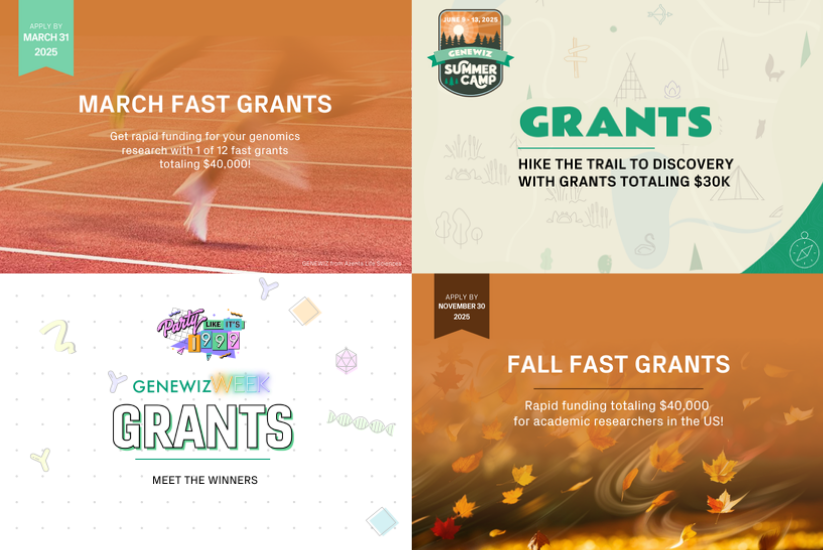
Looking Back at the GENEWIZ 2025 Grant Program
Totaling $150,000 in funds provided to scientific research, GENEWIZ’s 2025 grant program received greater than 1,500 applications and awarded 45 grants spanning 32 countries. Designed to catalyze significant advancements in scientific research, the grant program provides essential funding to researchers and institutions at the forefront of life sciences innovation. By easing early financial barriers, these grants enable investigators to pursue groundbreaking projects that might otherwise remain unrealized, especially in areas such as genomics, molecular biology, and clinical research.
These grants act as a springboard for transformative discoveries that have the potential to impact biological research fields, therapeutic developments, and innovative discoveries on a global scale.
Eligibility Criteria and Application Process
The 2025 grant program was open to academic researchers, clinical laboratories, biotechnology companies, and research organizations engaged in life sciences research. Eligible applicants demonstrated a clear scientific objective and a focus on advancing innovative methodologies or applications.
This year we streamlined the application process for efficiency and transparency. Prospective grantees submitted a research title and a short, detailed research abstract. Each application underwent a review process, with emphasis on scientific merit, potential impact, and alignment with our mission to accelerate discovery in the life sciences.
Maximizing Impact: Our Grants Advance Life Sciences Innovation
With a breadth of potential applications included in the funding program, including single-cell sequencing, spatial transcriptomics, proteomics, DNA and RNA synthesis, Antibody discovery and production, and AAV and Lentivirus production, these grants provide cutting-edge resources while driving efficiency, reproducibility and scalability within the research ecosystem.
The support provided extends beyond financial assistance, encompassing access to state-of-the-art GENEWIZ services and expertise. This holistic approach ensures that grantees can optimize workflow and achieve high-quality data that meets the stringent demands of life science research. Ultimately, GENEWIZ grants contribute to the rapid translation of scientific insights into new discoveries.
Success Stories: Real-World Stories from Grant Recipients
“…my PhD research [has] shown me how curiosity and persistence can lead to real discovery. I study how Alzheimer’s disease differs between sexes, focusing on astrocytes, which are the brain’s support cells, and how they change with age using the zebrafish model and cells.” – Fergus Woods, PhD Candidate at University College Dublin
“[My research] promotes sustainable agriculture by improving crop resilience to both abiotic and biotic stresses. By integrating physiology, molecular biology, and biotechnology, it aims to create a meaningful impact on food security and environmental health. Furthermore, it trains students in research methodologies and the outcomes of our studies, offering practical solutions and services to the farming community.” – Amaranatha Vennapusa, PhD, Research Associate at Delaware State University
“Pancreatic cancer is very deadly, with a 5-year survival rate of less than 10%. Many patients die within months of diagnosis because it is usually diagnosed at later stages, when there is nothing much doctors can do about it. There is so much we don’t know and we don’t understand about pancreatic cancer, and treatment options available are not effective and have terrible side effects. Science has given us the tools to look into various aspects of this disease, and I am hoping research like mine will help in providing better therapeutic targets.” – Fatima Farouk, PhD, Post Graduate Researcher at Coventry University
"I'm proud of my research because it lies at the intersection of marine science and human health, which is a very exciting niche to be working in. I believe that by studying the unique and fascinating life history traits of marine animals such as sea urchins (which are noted for their longevity and natural cancer resistance), we can make translational discoveries to improve human health. Just as the vast majority of the ocean remains unexplored, so too does its range of incredible biology, which I believe holds great potential for the discovery of novel natural products and therapeutics." – Riss Kell, PhD, Postdoctoral Scientist at Gloucester Marine Genomics Institute
Look for upcoming opportunities to participate in 2026 grant program!
Daily Insight
Recent Posts
Recent Post Tags
- next generation sequencing
- gene synthesis
- rna sequencing
- proteomics
- sanger sequencing
- transcriptomics
- antibody discovery
- olink
- Event
- GENEWIZ Update
- aav-itr
- cell and gene therapy
- itr sequencing
- aav plasmid prep
- antibody engineering
- genomics
- grant winner
- mRNA
- quantitative pcr (qPCR)
- rna therapeutics
- single-cell sequencing
- whole plasmid sequencing
- NULISA
- PacBio
- aav
- bioengineering
- bispecific antibodies
- digital pcr (dPCR)
- direct colony sequencing
- immunity
- lentivirus
- long-read sequencing
- oxford nanopore sequencing (ont)
- pcr + sanger sequencing
- peptides
- whole genome sequencing